How to check wedge distance gaps
Measure the typical carry of your pitching wedge and each specialist wedge with the same ball and repeatable swing. Subtract adjacent carry distances to find gaps, then compare those gaps with your normal distance variation and the shots your course requires.
In this guide
Start with carry, not the loft stamp
Loft is useful for selecting candidates, but equal loft steps do not prove equal distance steps. Titleist’s wedge selector links loft selection with distance gapping; its fitting material also considers strike, launch, spin, and turf interaction. Your own shots determine whether the set works together.
Include the set pitching wedge even if it looks different from your other wedges. Use a consistent ball and comparable conditions. If the monitor normalises flight, record that setting and use it throughout the comparison.
- Warm up, then record a group of representative shots with each wedge at your normal stock effort.
- Separate clearly failed device readings from real golf misses. Do not quietly remove short strikes to make the chart look cleaner.
- Record a typical carry and the spread of distances, using the same summary method for every wedge.
- Subtract each shorter club’s typical carry from the next longer club’s carry. Flag overlaps and gaps you struggle to cover.
- Build a separate chart for repeatable partial swings. Do not mix stock and partial shots in one average.
Test the shots between the numbers
A distance chart helps you ask better questions; it does not tell you that every golfer needs one exact spacing. A gap matters when it leaves a frequent shot you cannot play reliably. If two clubs overlap, one might still have a distinct bunker or greenside role.
Test relevant turf, rough, and bunker shots before changing the set. A loft change can also change how a wedge interacts with the ground. Ask a qualified fitter or club builder to assess bending suitability instead of changing loft solely to tidy a chart.
Repeat before replacing
Recheck the largest suspected gap on another day. If normal strike variation is larger than the gap, improving or understanding that variation may be more useful than buying another wedge.
Keep your chart with the ball, conditions, and date attached. Update it after an equipment change or a meaningful swing change. Treat it as a working reference rather than a promise of exactly how far the next shot will travel.
Calculate the gaps
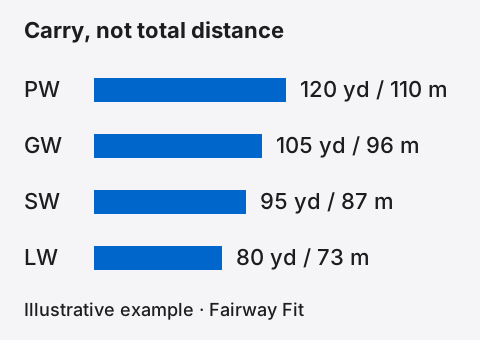
Illustrative carry distances, not recommendations or measured Fairway Fit results.
| Club | Typical carry | Gap from previous club |
|---|---|---|
| Pitching wedge | 120 yd / 110 m | — |
| Gap wedge | 105 yd / 96 m | 15 yd / 14 m |
| Sand wedge | 95 yd / 87 m | 10 yd / 9 m |
| Lob wedge | 80 yd / 73 m | 15 yd / 14 m |
The differences are calculated in yards and converted, so rounding may affect the displayed metre values. Test whether you can cover the 15-yard gaps with a comfortable partial shot before changing clubs.
Sources and context
- Titleist: Vokey wedge selectorLoft selection and the purpose of wedge distance gapping.
- Titleist: Jordan Thomas wedge-fitting overviewPublished overview of the fitting factors considered; not independent evidence of a guaranteed result.
Manufacturer guidance describes methods or products; it does not independently validate Fairway Fit. Examples on this page are illustrative. Read how our recommendations work.
Take the next step.
Use Fairway Fit to organise your wedge fitting direction and the next comparison to make.
Open the free fitting tool